The Author
Dr. Glen Power
Glen Power grew up in Perth’s southern suburbs and studied aquatic sciences at university. Glen was a fish biologist in his early career, and has published widely on fish biology and metabolism in fishes.
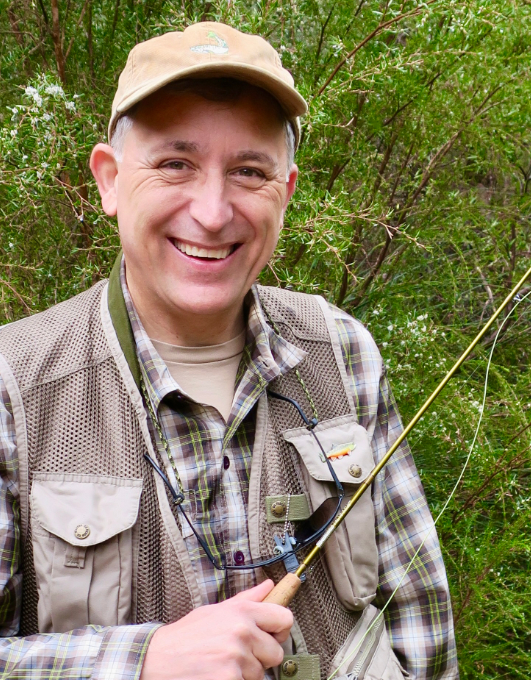
Glen Power is managing director of the Lions Eye Institute in Western Australia. A Rhodes Scholar with a doctorate in metabolic biochemistry from Oxford University, Glen originally studied science and law at Murdoch University, The University of Western Australia, Melbourne University, and Oxford University in the UK. For the past 27 years, Glen has been a chief executive officer of hospitals and health services around Australia, and also served as as chief of staff and principal policy adviser to the Minister for Health in Western Australia. He has published widely in the scientific and biomedical literature on fish oils, lipid metabolism and fish biology. This is his first book.
Author Q&A
Glen Power Q&A – Fly Fisherman
Could you start by telling me a bit about how you got into fly fishing and how your love of the sport developed in WA?
I began fly fishing when I was 12, and caught a tiny, bright little rainbow trout in the Collie River gorge. I cradled it in my hands, and kept the little fish for a few minutes in a billy full of water, mesmerised by its beauty. I eventually headed Dad’s plea to let it go. With a flick of its tail, it was gone, but my life was changed forever. My Dad was a soldier in the SAS regiment and he loved an adventure on weekends, exploring forestry maps and camping in the deep bush.
In 1979, I joined a fly fishing club – the WA Trout and Freshwater Angling Association – and used to go along and tie trout flies with a gusto, and generally just try to absorb everything I could about it. At 18 – in the 1980s - I was elected Vice President of that association, then President in my early twenties. The older members put up magnificently with my trout obsession, enduring endless phone calls from me, and yet they still took me fishing occasionally!
Can you explain some of the different aspects of what it involves? Can you run me through what a typical outing looks like?
Trout fishing, and freshwater fishing in general, requires a bit of planning before the outing and fair bit of ‘streamcraft’ once you are on the water. The weather plays a big part – is the stream flowing well, or will the rain discolour the water? Is it just too warm to find fish actively feeding? Trout are cold water species, and the best fishing is at the cooler times of the year, such as now through to November. This usually means rain! In warmer months, when the streams are lower, and the fish can be very timid, especially in shallow, clear creeks or lakes, there’s a lot of creeping about quietly on the bankside, peering over the top of bushes to try to ‘spot’ the fish before casting. Identifying what it is that the trout are feeding on - ‘matching the hatch’, as we say. In places that you can’t see the trout or what they are feeding upon, you can just give a cast with a nondescript fly (a ‘streamer’ or attractor pattern), and see if you can raise a fish from the depths. At other times, the fish will be actively ‘rising’ – which is when they splash the surface while intercepting flying or drifting fly life. This is hugely exciting with fish leaping out of the water right in front of you, missing your fly but taking something right near it! Landing a fish after all that effort – regardless of the size of it – is enough to send you home very happy.
For people who have never done the sport, how would you describe the experience?
Trout fishing is both art and science! Learning to fly cast is a well-described challenge, but eventually you grasp it. I used to go down the oval – best place to practice! Tying flies is great fun, especially with a group of mates on a weekend trip somewhere. There is often wine involved. Once you’ve learnt to cast and tie flies, to then succeed in finding and deceiving the fish, you end up having to be part biologist part entomologist, part meteorologist, part hydrologist! The places we fish are diverse – from gleaming expanses of lake, to raging rivers, tiny scrubby streams in deep bush or quiet farm dams surrounded by cattle. You need to have a strong appreciation of your environment and an understanding of all the land uses going on around you. Doing the right thing by farmers is such an important part of it, when you gain access on private land to go and have a cast. Once you are on the water and focused on a trout, the hours pass you by.
Where are your favourite locations in WA? What fish do you catch – is it just trout?
My favourite location for fly fishing in WA is the wet Southern Forests region, from Bridgetown to Manjimup and Pemberton and across the south coast right round to Albany. That might on one day be on a wide karri forest river, clambering about on the big boulders amongst the rapids, or the next day gently flicking a small fly in a tiny headwater creek. Farm dams are also an enormous underexploited angling resource in WA, offering great fishing when they are stocked with trout. A relatively small dam in the southwest can produce trout of 2-3kg in only a couple of years. There are literally thousands of waters with that potential in WA and yet only as tiny fraction are stocked annually. One such dam – Bob and Judy McCarthy’s dam at Williams - produced some of the best trout angling in Australia, and for many years.
Can you tell me about one of your most exciting experiences and unforgettable moment as a fly fisherman?
My most exciting experience fly fishing is always finding a new water somewhere, whether a little creek that has been long overlooked, or the bend in the river that I’d never been around before. One summer, my Dad and I walked and waded into a remote stretch of the Donnelly River near Beedelup, which we’d never been to previously. It was one of those ‘singing hot days’, the bush in full chorus. We saw rakali curling about among the logs, big black marron lumbering across the sunlit riverbed, we startled ducks and kangaroos with our unexpected intrusions. We saw and caught a couple of lively trout too, but to be honest sometimes the fish become quite secondary. Trout angling communes you fully with nature. When nowadays I’m with my own two young boys, in the sun on a babbling creek, it’s all about ‘just being’.
What do you love most about the sport and being a fly fisherman in WA?
Fly fishing across the vast southwest of WA takes you to some of the most beautiful places imaginable. The sound of fresh running water reaches into and quenches you, and ever more so in the hotter, drier years. I love the abundance of a wet year, and to find a trout holding in a cold current somewhere.
What's your advice/top tips for people who maybe be interested in getting into fly fishing in WA?
My advice would be to join a club (there are four in Perth and the south-west, catering to fly fishers), check out the various Facebook pages related to freshwater fishing, and read a bit about the unique history. I have just written a new book entitled ‘Trout in Western Australia’, which features all the rivers, streams and lakes from Gingin to Albany.
Any other interesting or exciting points you think our readers would enjoy?
Fly fishing is a sport for life, and one which can take you to some extraordinary places around the world, too. I’ve been lucky in my forty-plus years to spend time with mates fly fishing in the glacial rivers of New Zealand, alpine ponds high in the US Rockies, gentile chalk streams in green dales of England and little dark lochs nestled in Scottish moors. Wherever it is that you meet another fly fisher, you’ll speak the same language. We are hardwired the same!